For operations and support leaders
AI worked. Now what?
The pilot succeeded. The dashboard turned green. Now the harder questions arrive.
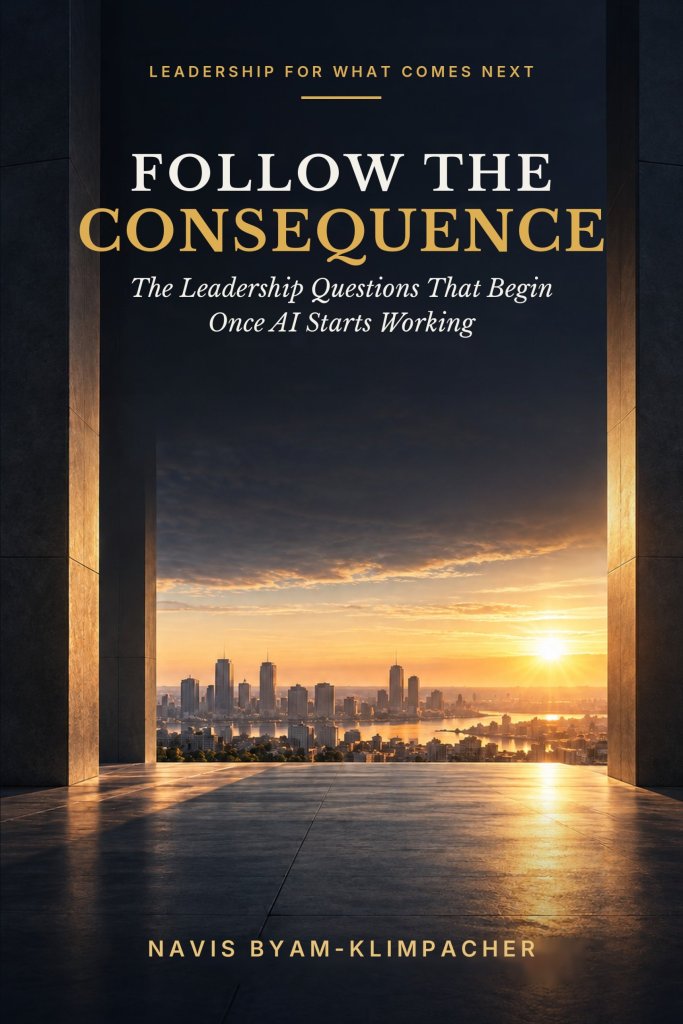
Follow the Consequence: The Leadership Questions That Begin Once AI Starts Working is written for the people who have to run the organization after the AI program is declared a success.
Kindle ebook and paperback on Amazon. Ebook on Kobo and other stores.
The questions nobody planned for
For years, organizations have been asking what AI can do. Can it answer the customer? Resolve the ticket? Review the contract? Complete the workflow without someone directing every step?
Increasingly, the answer is yes. That is where a different set of leadership questions begins.
- What happens to the time people get back?
- If AI handles the routine work, does the work that remains become harder?
- If one team suddenly produces twice as much, what happens to the next team in the process?
- When AI moves from recommending to acting, who decides how much authority it should have?
- Six months after the dashboard turns green, how will you know whether any of this actually made the business better?
None of those questions means the technology failed. They exist because it worked.
You may own the service desk, the support function, a shared-services team or the operations behind a business unit. Either way, you are the one who will be asked what should happen next. This book is built for that moment.
The first result
The first result may be right without being complete
Suppose AI gives a team 20 percent of its time back. That’s real. But what should the 20 percent become? More output? Better service? Growth? Employee development? Lower cost? Fewer people? Or will demand simply consume the capacity before anyone realizes it was there?
The productivity gain cannot answer that question. Leadership has to.
Now imagine AI makes one part of a workflow dramatically faster. The dashboard looks excellent. Then another team starts struggling. Did AI fail? Not necessarily. The first improvement may have been completely real.
The consequence simply traveled.
The evidence
A real gain still leaves a decision
When researchers followed 5,172 customer support agents as a generative AI assistant entered their work, issues resolved per hour rose about 15 percent on average. Less experienced agents saw the largest gains. (Brynjolfsson, Li and Raymond, Generative AI at Work, The Quarterly Journal of Economics, 2025)
That is a real productivity gain. It doesn’t tell you what the recovered time should become, whether the remaining work just got harder, or which team receives the extra output next. Those answers belong to leadership.
The technology can complete the task. The organization has to decide what happens because it did.
From Follow the Consequence
Possibility is not a decision
AI can perform the task. That tells you something about capability. It does not tell you whether the task should still exist.
AI can save time. That doesn’t tell you what the recovered capacity should become.
AI can make a decision. That doesn’t tell you whether it should have the authority to act on it.
AI can make an organization more productive. That doesn’t tell you what the business gained.
What AI makes possible and what leadership should do because of it are different questions. Follow the Consequence is about the space between them.
The framework at the heart of the book
The Follow the Consequence loop
Five questions that keep you looking past the first visible result. It starts with one: What became possible? The full loop, and how to work through it with your team, is inside.
Before you decide
Every chapter ends with the questions to work through before a real decision is made. The Leader’s Toolkit at the back collects them in one place, ready for your next planning meeting.
Capability creates the possibility. Permission creates the organizational consequence.
What you will be able to do
Inside, you will learn how to
- See what AI is really changing in your organization, beyond the first result
- Decide what the time AI frees up should become
- Show leadership what the business actually gained
Grounded in real operations
Drawn from the work, backed by the research
The book draws on 30 cited research and industry sources. It is grounded in real operating experiences from the author’s career, anonymized. In one, a service desk automated a single task, turning incoming emails into tickets, and within weeks the queue looked flooded.
That was the real change. Demand had not jumped. Visibility had.
From Chapter 9, Measure Past AI
What’s inside: ten chapters follow a change from the first automated task to the whole organization: the work, the people, the authority, the structure and the results. Plus the Introduction, the Conclusion, the Leader’s Toolkit and full endnotes.
Not a book against AI
For leaders who want AI to succeed
This is not an argument against AI. It is not an argument for preserving every job or keeping a person inside every workflow, and it is not another warning that leaders should slow down until every consequence can be predicted.
If AI can perform work better, faster and at lower cost, that matters. Some roles will change. Some will disappear. New ones will emerge. Some AI systems should receive more authority when the evidence supports it.
The goal isn’t to preserve yesterday’s organization. It’s to understand what AI changed well enough to make an intentional decision about what should replace it.
About the author
Navis Byam‑Klimpacher
Navis Byam-Klimpacher has spent more than twenty years in technology operations across financial, legal and professional services organizations. Her work has included support, field services, training, audiovisual services and geographically distributed teams.
That experience taught her to pay attention to what happens when a change reaches the people and systems that have to live with it. She is the founder of Starvest Collective, an online community and resource for leaders working through AI transformation.
You do not need to predict the future to lead into it
You can understand the work in front of you. You can decide rather than assume. You can measure rather than declare victory. And when reality gives you better information, you can change the decision.
Start following the consequence. Get your copy of Follow the Consequence today.
Kindle ebook and paperback on Amazon. Ebook on Kobo and other stores.
Not ready to read yet? Take the free AI Consequences Check.
Rate 12 statements and see whether consequences are in view, building or out of sight in your organization.

